The Future of Tracking Tools & Assets
Process & Technology Solutions at GigaTrak • Reading Time: 7 mins
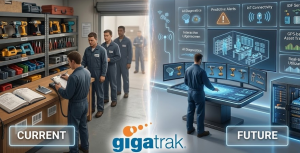
Tool rooms have always been the heartbeat of industrial operations—controlling access to critical equipment, maintaining tool integrity, and ensuring production uptime. But the way organizations track, manage, and optimize tool room assets is undergoing a major transformation. What was once a manual, paper-based process is rapidly evolving into an intelligent, connected ecosystem powered by a mix of barcodes, RFID, IoT, GPS, and AI-driven analytics.
From Manual Control to Real-Time Visibility
Traditional tool room management relied heavily on manual check-in/check-out systems or disjointed spreadsheets. While these methods provided basic accountability, they required heavy administration and offered zero visibility once tools left the room.
Modern industrial asset tracking is shifting toward real-time visibility systems that continuously monitor location, usage, and condition. Advanced automated data capture—including RFID, Bluetooth Low Energy (BLE), GPS, and IoT sensors—is expanding on traditional tracking. This shift allows organizations to instantly know where a tool is, who is using it, and how often it is being utilized.
RFID and GPS Become the Backbone of Tool Room Tracking
RFID has become one of the most widely adopted technologies in high-velocity tool tracking environments. Unlike traditional barcodes, RFID does not require a direct line-of-sight scan, allowing entire tool cabinets, mobile carts, or storage bins to be read simultaneously.
In industrial settings, RFID systems can reduce asset search times from minutes to seconds, drastically improving tool availability and utilization rates. Looking ahead, RFID tags are becoming even more advanced, moving beyond simple identification to logging tool-specific usage cycles and feeding data directly into predictive maintenance models. Meanwhile, GPS remains the gold standard for monitoring high-value, larger equipment as it moves across various job sites in the field.
The Rise of IoT-Enabled Smart Tool Rooms
The next evolution is the fully connected “smart tool room.” In this model, every asset becomes a data-generating device. IoT sensors attached to specialized tools or storage systems can monitor:
- Location: Seamless handoffs between indoor and outdoor tracking.
- Usage Frequency: Real-time data on active run-times.
- Environmental Health: Monitoring temperature spikes and abnormal vibrations.
- Maintenance Needs: Automatic alerts based on real wear-and-tear.
This continuous stream of data populates real-time dashboards that show tool availability, asset health, and utilization trends at a glance. By 2028, IoT is expected to play a central role in asset intelligence systems, permanently shifting tool tracking from reactive troubleshooting to proactive management.
Artificial Intelligence Turns Data Into Decisions
As tool rooms generate more data than ever before, artificial intelligence becomes essential for making sense of it all. AI-driven systems can:
- Predict tool failures before they happen on the floor.
- Recommend optimal tool replacement and procurement schedules.
- Detect unusual usage patterns or sudden theft risks.
- Automatically update asset lifecycle and depreciation records.
Instead of simply telling managers where tools are, future systems will actively advise them on what action to take next.
Predictive Maintenance Changes the Game
One of the most impactful shifts in modern asset management is the move from reactive to predictive maintenance. Instead of servicing tools after a costly breakdown, connected systems anticipate failures based on real-time usage and condition data.
This reduces unscheduled downtime, extends tool lifespans, and lowers overall operational costs. Industrial studies consistently show that predictive maintenance can significantly reduce unplanned downtime by identifying minor failure signals early through integrated IoT and analytics systems.
Digital Twins and Full Asset Lifecycle Tracking
A growing concept in advanced facilities is the “digital twin” of the tool room. This is a virtual model of all physical tools and assets that mirrors real-world conditions in real time. With digital twins, organizations can simulate:
- Tool demand and constraints during production peaks.
- Optimal maintenance scheduling around active shift changes.
- Long-term asset depreciation and total cost of ownership (TCO).
This creates a fully transparent, optimized asset ecosystem rather than isolated tracking silos.
Integration With Enterprise Systems
The future tool room does not operate in isolation. To unlock its full value, tool data must be deeply integrated with core enterprise software, such as:
- ERP (Enterprise Resource Planning) for streamlined procurement.
- CMMS (Computerized Maintenance Management Systems) for automated work orders.
- Inventory Management Platforms to sync tool availability with raw material staging.
This tight integration ensures that tool room metrics directly and positively impact broader production scheduling and corporate financial planning.
What the Tool Room of the Future Looks Like
In a fully modernized industrial environment, a tool room will function as a seamless, automated hub:
- Hybrid Tagging: Assets use a mix of tracking tech tailored to their value and ruggedness.
- Frictionless Log-Ins: Tools automatically register as checked out or returned the moment they pass through a portal.
- Secure Access: Employees utilize badges or secure mobile credentials for instant, accountable access.
- Anomalies Flagged: AI constantly monitors usage patterns to immediately flag missing or misplaced items.
- Smart Alerts: Predictive insights schedule maintenance and calibration days before a tool can fail.
- Elimination of Spreadsheets: Managers run operations from dynamic, real-time dashboards.
The result is a secure facility ecosystem that is faster, safer, and significantly more cost-efficient.
Conclusion: Building the Future with GigaTrak
While the long-term future of tool tracking points toward full automation and AI-driven ecosystems, navigating this shift requires a practical, phased approach. Technologies like barcodes may eventually see their roles shift as scanning automation matures, but right now, a robust barcode tracking system remains the single most effective, reliable, and cost-efficient foundation for industrial operations. True asset intelligence cannot exist without first mastering disciplined, accurate data collection—and this is where GigaTrak excels today.
GigaTrak believes in providing solutions that deliver immediate operational value while being engineered to scale. Currently, the best system uses barcodes. As the industrial landscape evolves, so do we. Furthermore, the integration of tracking systems with enterprise software ensures that tool room metrics align with overall business objectives. As we look to the future, embracing these advanced tracking solutions will be essential for unlocking greater efficiency and maximizing productivity in industrial operations.
Schedule a demo and see the difference for yourself at Gigatrak.com.
