
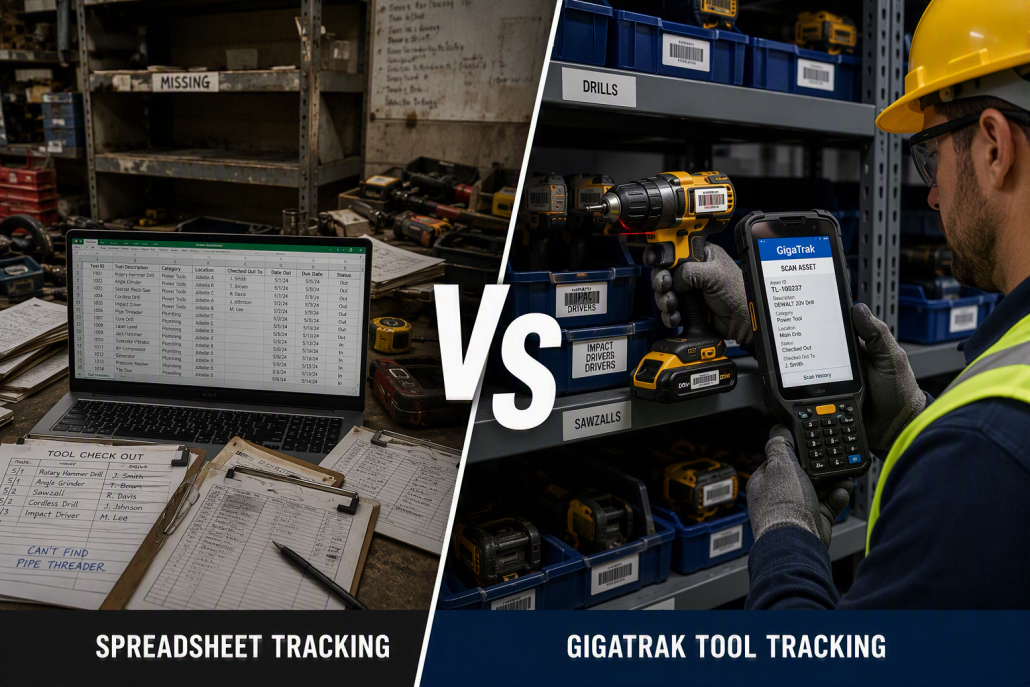
Tool Tracking Software vs. Spreadsheets: Hidden Costs Revealed

Tool Tracking Software vs. Spreadsheets: What’s Really Costing You?
A crew arrives at a jobsite at 7:00 AM. They open the truck bed to start work, but the pipe threader is missing. The foreman calls the main shop, checks three other drivers, and searches through last week’s paper logs. Two hours later, four technicians are still sitting idle while someone drives to buy a duplicate tool.
If you manage operations, fleets, or jobsites, this scenario happens weekly. Most companies try to track physical gear using Excel or Google Sheets. What seems like a free solution quickly becomes a major operating expense.
Tool tracking software is a barcode-based system that monitors physical equipment across jobsites, warehouses, and service vehicles in real time.
Switching from static spreadsheets to dedicated software plugs silent financial leaks. You will know where every tool is before your crew leaves the yard.
The Hidden Financial Costs of Spreadsheet Tool Tracking
Spreadsheets work well for static accounting data. They fail when managing physical equipment moving between crews, trucks, and job sites.
Wasted Labor and Paid Downtime
Field technicians spend an average of 30 minutes every day searching for lost gear or calling other crews to locate assets.
Across a team of 10 field technicians, that equals 1,300 hours lost per year in pure downtime. You pay high-cost labor hours for employees to dig through truck beds and drive back and forth across town.
Human Error and Ghost Inventory
Research shows 88% of manually updated spreadsheets contain human errors. A missed row or a simple typo creates ghost inventory. These are tools that exist on your balance sheet but are nowhere to be found when a project kicks off.
Your team ends up panic-buying expensive duplicate tools or renting last-minute equipment just to stay on schedule.
Zero Real-Time Visibility
Spreadsheets rely on manual updates at the end of the day or week. By the time a manager opens the file on Tuesday morning, the data is useless.
Without instant updates, you lose control the moment an asset leaves your central crib or warehouse.
Equipment Loss and Shrinkage Metrics
Missing equipment directly erodes profit margins. Construction and field service operations lose 5% to 10% of their portable tool inventory every year to theft and misplacement.
| Financial Impact Category | Spreadsheet Tracking Performance |
|---|---|
| Annual Equipment Loss | 5% to 10% total inventory loss per year |
| Tool Recovery Rates | Under 7% without systematic barcode checkouts |
| Duplicate Tool Buys | $3,000+ per 50 workers spent on unnecessary replacements |
Without an automated system linking equipment directly to individual workers, recovery rates remain low. Most businesses absorb these replacement costs out of pocket.
4 Crucial Features Missing from Spreadsheets
Why do spreadsheets fail to stop equipment loss? They lack four built-in capabilities that dedicated tracking systems provide.
1. Fast Barcode and QR Code Scanning
Instead of typing serial numbers into a tiny cell, staff use durable barcode scanners or mobile devices to scan tags. A check-out process that used to take three minutes now takes two seconds.
2. Digital Chain of Custody
When high-value gear changes hands, the software records an exact digital paper trail. Employees sign for tools directly on screen, establishing immediate personal accountability.
3. Automated Maintenance Alerts
Tools require periodic calibration, safety checks, and routine servicing. Spreadsheets do not alert you when a saw needs maintenance. Tracking software sends automatic alerts to fleet managers before faulty gear causes a jobsite injury.
4. Location Tagging and GPS Mapping
When an asset is scanned, the system records the location coordinates. Managers get a clear view of where tools were last checked out, making it easy to identify which truck or crew has the item.
Tool Tracking Software vs. Spreadsheets: Side-by-Side Comparison
| Feature | Excel / Google Sheets | Dedicated Tool Tracking Software |
|---|---|---|
| Data Entry | Manual typing with high typo risk | Instant barcode and QR code scanning |
| Real-Time Sync | Requires manual saves and updates | Instant cloud or local server sync |
| Accountability | Relies on memory and paper logs | Digital signatures and audit histories |
| Maintenance | Forgotten dates and missed service | Automated alerts for inspections |
| Deployment | Basic file hosting only | Cloud hosting or secure on-premise install |
Built for High-Security and Complex Operations
Generic office software cannot handle complex security requirements. GigaTrak has provided barcode tool tracking solutions for over 30 years.
Clients like FDNY, Lockheed Martin, the US Army, and Virginia Public Schools rely on GigaTrak to keep their physical assets organized.
Unlike vendors that force you into a one-size-fits-all cloud system, GigaTrak offers both cloud and secure on-premise deployments. If your facility operates without an internet connection or requires self-hosted security, on-premise software keeps your data within your internal network. All support is based directly in the United States.
Calculating Your ROI
Upgrading to dedicated software pays for itself quickly. Calculate your potential savings using three operational numbers:
-
Labor Hours Lost: Multiply your average technician pay rate by 0.5 hours per day. Multiply that number by your total crew size and working days per year.
-
Annual Tool Loss: Sum up what you spent over the last 12 months replacing lost, stolen, or unreturned gear.
-
Preventable Rentals: Add up the expense of last-minute tool rentals ordered because nobody knew where company-owned items were located.
Most mid-sized operations recoup their investment within 3 to 6 months by eliminating duplicate buys and recovering lost labor hours.
How to Transition Off Spreadsheets
Moving off manual spreadsheets does not need to disrupt daily work:
-
Audit High-Value Inventory: Start with power tools, testing gear, and specialized equipment. Do not worry about tagging small hand tools on day one.
-
Apply Durable Barcode Tags: Attach heavy-duty, weather-resistant barcode or QR tags to your assets.
-
Establish a Checkout Rule: Make scanning mandatory before gear leaves the crib. Because scanning takes seconds, field adoption happens quickly.
Frequently Asked Questions
What is tool tracking software?
Tool tracking software is a specialized application that uses barcodes, QR tags, or RFID to record who has an asset, where it is located, and when it is due back. It replaces manual logs and spreadsheets.
Can tool tracking software run on-premise without an internet connection?
Yes. GigaTrak provides on-premise installations that run entirely on your local network. This setup is ideal for government agencies, military bases, and high-security contractors.
How does barcode scanning improve inventory accuracy?
Barcode scanning eliminates manual typing errors. Scanning a barcode instantly updates the database, changes asset ownership, and logs precise timestamps in under two seconds.
Is US-based technical support available?
Yes. GigaTrak provides dedicated, US-based support to help set up hardware, configure databases, and train your staff.
Stop Letting Spreadsheets Drain Your Profits
Spreadsheets are fine for accounting. They are the wrong tool for managing moving physical equipment across jobsites and service vans.
Take control of your inventory, improve accountability, and keep your crews working.
Request a Consultation with GigaTrak today to speak with our US-based team and find the right cloud or on-premise setup for your operation.
Contacting GigaTrak:
- 262-657-5500
- sales@gigatrak.com
Request a Free Demo.
Contact Page.