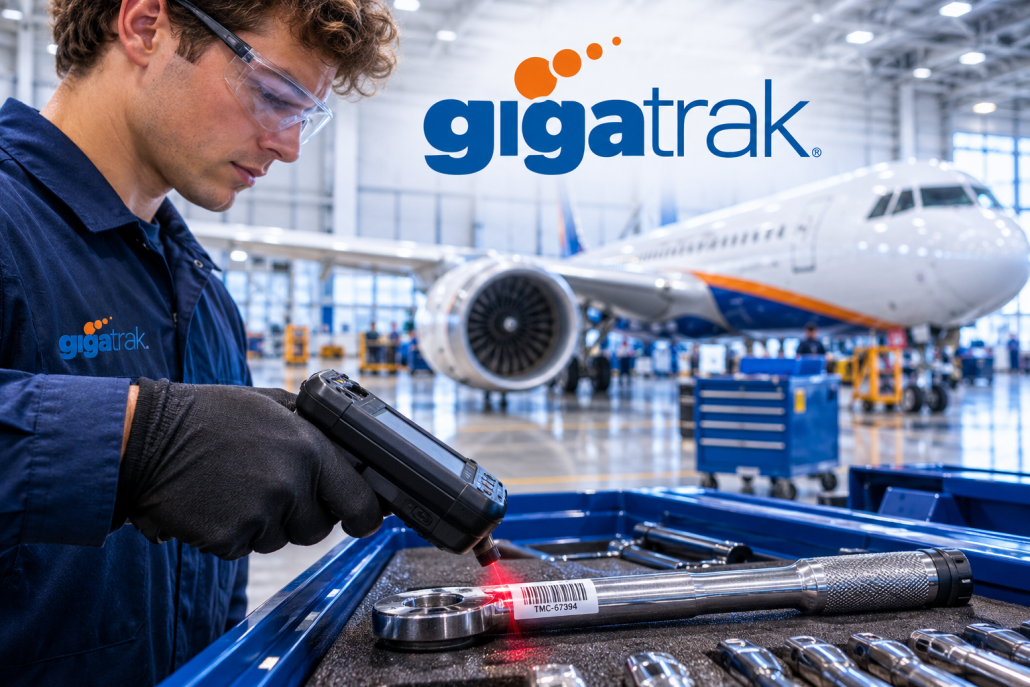
How Barcode Tool Tracking Improves Accountability in Aviation Maintenance
An aircraft sits on the tarmac. Departure is set for 20 minutes from now. Suddenly, a technician notices a $50 socket wrench is missing from a toolbox.
Work stops immediately. The hangar crew locks down the bay, pulls access panels, and starts a grid search across the airframe. The departure is canceled. The airline takes an Aircraft On Ground (AOG) penalty that costs over $10,000 per hour. If that missing tool stays inside an engine intake or flight control bay, it becomes Foreign Object Damage (FOD). That causes catastrophic mechanical failure.
A missing $50 tool can cost an operation tens of thousands of dollars in minutes.
To solve this, aviation maintenance, repair, and overhaul (MRO) facilities use
barcode tool tracking.
Barcode tool tracking is a digital inventory method that uses unique barcode labels to log tool checkout, location, calibration, and return in real time.
For 30 years, GigaTrak has provided barcode tracking systems to high-consequence organizations like Lockheed Martin, the US Army, the FDNY, and commercial MRO facilities. GigaTrak offers both cloud-hosted and on-premise deployments backed by 100% US-based support.
The Real Operational Cost of Legacy Tool Tracking
Federal Aviation Administration (FAA) regulations under 14 CFR Part 43 and Part 145 require MRO facilities to maintain strict quality control systems. Every tool must be accounted for before an aircraft is approved for service return.
Despite these rules, many hangars still rely on manual tracking methods. These methods fail under daily production pressure.
| Tracking Method |
Primary Operational Limitation |
Accountability Deficit |
| Paper Sign-Out Sheets |
Technicians skip entries or write illegibly during busy shifts. |
Audits take hours. Real-time tool locations remain unknown. |
| Open Access Tool Cribs |
Relies on voluntary compliance and memory. |
Missing tools are discovered days later. Misplacement goes untracked. |
| Physical Shadow Boards |
Shows that an item is missing from the board. |
Does not record who took the tool, which aircraft it is on, or when it is due back. |
Clipboard sign-outs and honor systems create blind spots. When a tool goes missing at shift change, supervisors waste valuable hours interviewing crew members instead of clearing aircraft.
The Mechanics of Foreign Object Damage (FOD) and Critical Tool Zones
Foreign Object Damage is one of the leading avoidable expenses in aerospace operations. According to industry estimates, FOD costs the aviation industry billions of dollars annually in equipment repairs, delayed flights, and safety incidents.
In an active hangar, tools do not simply vanish into thin air. They fall into tight, confined structural areas during routine maintenance:
-
- Flight Control Cable Bays: A small 1/4-inch drive socket dropped into a cable channel can jam elevator or rudder controls, causing sudden mechanical restriction during flight.
- Engine Intake Nacelles: A forgotten safety-wire plier or screwdriver bit ingested into a turbofan engine will destroy compressor blades in fractions of a second, causing immediate engine failure.
- Avionics & Electrical Compartments: Metallic tools left near open terminal blocks create short circuits, leading to electrical fires or instrument failure in flight.
- Fuel Tank Cavities: Tools left behind inside wet wings or bladder tanks contaminate fuel systems and block pumps.
Manual tool control cannot guarantee these zones stay clean. Once an access panel is sealed over a trapped tool, visual inspection is impossible. Barcode tool tracking establishes an absolute digital clearance process. If a single tool checked out to that tail number remains unreturned, the system prevents job sign-off before the panel is closed.
Breakdown:
How Barcode Tool Tracking Enforces Individual Responsibility
Digital barcode systems eliminate guesswork. By scanning barcodes on employee badges, tool crib containers, and individual assets, the software creates an undeniable chain of custody.
When a mechanic needs a calibrated torque wrench, they scan their ID badge, then scan the barcode on the wrench. The system records the transaction instantly:
- Exact technician identity
- Precise timestamp
- Work order number or aircraft tail number
- Scheduled return time
If the wrench is not back in the crib at the end of the shift, the software flags the exact technician who signed it out. This removes finger-pointing and forces personal accountability.
2. Rapid Kit and Assembly Verification
Mechanics rarely work with single tools. They use heavy toolboxes containing dozens or hundreds of items.
Scanning individual tools out of a 100-piece kit takes too long. GigaTrak solves this with master kit tracking. The system links every individual component to a single master barcode on the container.
A technician scans the main container barcode to check out the entire kit. At shift end, the tool crib manager scans the container and performs a quick item audit. The software highlights missing pieces instantly.
3. Automated Calibration Enforcement and Precision Airworthiness
Precision tools require continuous calibration tracking. Torque wrenches, micrometers, and pressure gauges lose accuracy over hundreds of compression cycles.
If a mechanic uses an under-torqued wrench on a critical flange or landing gear assembly, the fastener can back out during operation. Over-torquing can strip aircraft-grade titanium threads or crack composite materials.
GigaTrak tracks calibration expiration dates for every asset down to the individual serial number. When an item reaches its calibration deadline, the system flags the record and blocks technicians from checking it out. The tool remains locked out of service until certified inspection records are entered into the database, protecting structural integrity.
Regulatory Compliance: Meeting NAS 412 Standards and FAA Audits
Aviation quality management relies on standardized safety frameworks. One primary standard is National Aerospace Standard (NAS) 412, which defines strict Foreign Object Elimination (FOE) protocols for aerospace manufacturing and maintenance.
NAS 412 requires MROs to maintain complete positive tool control. This means an organization must prove:
-
- Who brought every tool onto the aircraft.
- Where every tool is during active maintenance.
- That 100% of tools are verified back in storage before flight sign-off.
When FAA Part 145 inspectors perform spot audits, they demand immediate verification of these protocols. Under a paper system, proving compliance requires pulling binders of hand-written logs, cross-referencing serial numbers, and searching for physical calibration stickers.
Barcode tool tracking simplifies audit compliance. A quality supervisor can pull up complete, unalterable historical logs for any aircraft, technician, or tool within seconds.
Financial Analysis: Manual Tool Searches vs. Barcode Efficiency
When a tool goes missing in a manual crib environment, the hidden labor costs accumulate quickly. Consider a typical missing tool scenario on a hangar floor:
-
- 15 Mechanics halted for a mandatory grid search.
- 2 Hours spent inspecting airframe cavities, toolboxes, and trash bins.
- 30 Wasted Direct Labor Hours at an average shop rate of $120/hour = $3,600 in lost direct labor per incident.
Add the potential cost of an unexpected AOG flight cancellation, which often exceeds $10,000 per hour in passenger rerouting, gate fees, and late penalties.
With barcode tool tracking, a missing item is identified before the shift ends. The system shows exactly who checked the item out, which work order it was assigned to, and when it was taken. Instead of idling 15 mechanics for hours, the shift supervisor walks directly to the specific technician or work area to retrieve the asset in minutes.
Key Features Required for Barcode Tool Tracking Software
Aviation maintenance requires software built for high-reliability environments. When evaluating software options, ensure the system includes these operational capabilities:
Military defense contractors and high-security MROs often require local database installation due to strict data privacy or IT security policies. Other facilities prefer cloud hosting for multi-site access. GigaTrak provides both native on-premise network installations and secure cloud deployments to match your IT infrastructure.
Ruggedized Mobile Scanning
Maintenance happens on ramps, inside airframes, and across wide hangar floors. Hardware scanners and ruggedized mobile handhelds allow technicians to execute check-ins, check-outs, and location transfers directly at the aircraft.
Detailed FAA Audit Reporting
During an FAA quality audit, you must prove that your tool management processes meet safety standards. GigaTrak generates historical audit logs in seconds. You can pull complete transaction histories for any tool, employee, or work order across its entire operational lifespan.
Step-by-Step Implementation for Hangar Tool Control
Upgrading from paper logs to digital barcode tool tracking requires an organized rollout. Follow these four steps to ensure operational adoption:
Step 1: Catalog Assets and Assign Unique Identifiers
Gather every tool, diagnostic device, and portable asset in the facility. Record the serial number, model, manufacturer, and calibration schedule. Input this data into the
GigaTrak Tool Tracking System to establish your primary inventory database.
Step 2: Apply Industrial-Grade Barcode Tags
Standard paper labels fail quickly in hangars. Hydraulic fluid, jet fuel, degreasers, and extreme heat destroy paper tags. Use industrial anodized aluminum tags or heavy-duty ceramic barcode labels designed for aviation environments.
Step 3: Establish Shift Change Audit Protocols
Build scanning into your standard operating procedures. Require technicians to scan all checked-out tools back into the crib 15 minutes before the end of their shift. Run an automated missing tool report before handing over the bay to the incoming crew.
Step 4: Train Hangar Personnel
Show technicians how barcode tool tracking protects them. Digital check-outs prove exactly when an item was returned, shielding workers from unfair blame if an asset is lost by another team.
Frequently Asked Questions About Barcode Tool Tracking
How do you track tools in aviation maintenance?
Aviation facilities track tools using industrial barcode labels attached to individual tools and toolboxes. Technicians scan their employee ID badge and the tool’s barcode using mobile handheld devices or fixed crib terminals. This logs the user, timestamp, work order, and return deadline into a central database.
What is FAA tool compliance?
FAA tool compliance refers to quality control requirements under 14 CFR Part 43 and Part 145. These rules require MRO facilities to account for all tools used during maintenance, verify calibration schedules, and maintain detailed inspection records to prevent Foreign Object Damage (FOD).
What is the NAS 412 standard for tool control?
NAS 412 is the National Aerospace Standard for Foreign Object Elimination (FOE). It outlines specific guidelines for preventing FOD, including mandatory positive tool control, tool crib management, calibration tracking, and shift-change tool accounting.
Can barcode labels withstand harsh hangar chemicals?
Yes. Industrial barcode labels built for aviation use materials like anodized aluminum, thermal polyester, or specialized ceramic coatings. These tags resist exposure to Skydrol, jet fuel, solvents, abrasion, and high temperatures.
How does barcode tracking assist with FAA audits?
Barcode software maintains an unalterable digital log of every tool transaction, calibration certificate, and maintenance repair. During an FAA audit, supervisors can generate complete tool history reports instantly instead of searching through paper logs.
Does GigaTrak support both cloud and on-premise installations?
Yes. GigaTrak offers both cloud-hosted environments and self-hosted on-premise installations. This gives military bases, defense contractors, and commercial airfields full control over their data security requirements.
Take Control of Your Hangar Tool Crib
Unaccounted-for tools put aircraft, passengers, and maintenance operations at risk. Paper logs and manual crib systems do not give you the speed or control required to meet modern FAA safety mandates.
GigaTrak gives you direct visibility over every tool in your inventory. With 30 years of field experience, US-based support, and flexible deployment models, GigaTrak helps MRO facilities eliminate tool loss and pass audits with confidence.
Ready to protect your operations and enforce tool accountability?